Practical guide
Motorcycle Riding Laws by Country: Licences, Insurance & Documents
Licence categories, insurance paperwork, and the road rules that actually differ once you cross a border — country by country for Spain, Portugal, Morocco, Italy, France, and Germany. This is practical information, not legal advice: rules change, so verify anything critical with the official national road authority before you travel.

By Ben Crawford, Co-founderUpdated 19 de outubro de 2026
The numbers worth knowing
The key figures behind this guide, from riders and operators across the marketplace.
Browse all tripsKey takeaways
- Most tour-hire fleets accept EU A and A2 licence categories; a full direct-access A licence requires a minimum age of 24 in the EU.
- The typical blood-alcohol limit in Western Europe is 0.5 g/l, and lower for novice riders.
- This is practical guidance, not legal advice — rules change, so confirm anything critical before you ride.
Motorcycle holidays across Europe and Morocco
View all →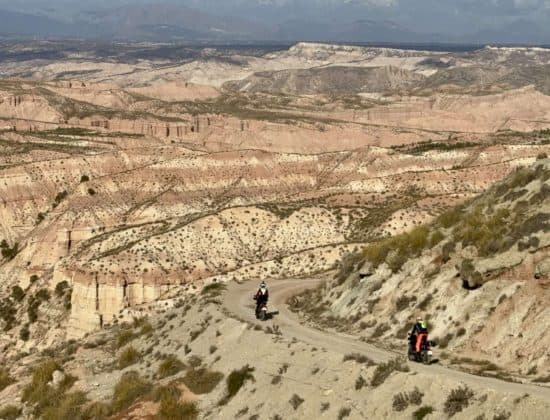 Adventure Touring
Tour de Mota Todo-o-Terreno pela Andaluzia Oriental
Andalusia, Spain
6 – 11 de nov. · 6 days · Aries Moto Tours
€1,490 / person
 Road Touring
O Derradeiro Tour Gourmet
Andalusia, Spain
Dates on request · 8 days · Gourmet Biker Tours
€4,366 / person
 Road Touring
Signature Gourmet Tour
Andalusia, Spain
Dates on request · 8 days · Gourmet Biker Tours
€3,021 / person
The foundation
How motorcycle licence requirements work across Europe
The good news for anyone planning to ride a motorcycle in Europe is that licence categories are harmonised across the EU. The same framework applies from Lisbon to Munich: category A1 covers 125cc machines (minimum age 16 in most countries), A2 covers bikes up to 35 kW (minimum 18), and the unrestricted category A requires either two years on an A2 licence (so from age 20) or direct access at 24. A full licence issued in any EU or EEA country is valid in every other one, with no extra paperwork — ride into Spain on a German A licence and you are as legal as a local.
Whether you also need an International Driving Permit depends on where your licence was issued. A UK photocard licence needs none in Spain, Portugal, France, Italy or Germany, though carrying a 1968 IDP is still often recommended for Morocco (more below). Riders licensed elsewhere outside the EU, in the US, Canada or Australia for example, should carry one alongside their national licence: requirements vary by country, an IDP costs little, and rental desks often ask for it. Rental and tour operators add their own layer on top of the law: most hire fleets require a full A licence held for at least two years, and riders aged under 21 or 25 may face young-rider surcharges or restricted models. Check the trip listing’s requirements before booking, not at the pick-up counter.
Two more constants apply everywhere in this guide. Helmets meeting ECE standards are mandatory in every country covered here, for rider and pillion alike. And 112 reaches the emergency services in every EU country, from any mobile and on a foreign SIM card, alongside each country’s own numbers. In Morocco, the emergency numbers are 190 for police, 177 for the Royal Gendarmerie on rural roads, and 150 for an ambulance or the fire service. Helmets are required there too, though enforcement of helmet standards differs — more on Morocco below.


Iberia
Riding laws in Spain and Portugal
Spain is where most riders on this site will first meet a Guardia Civil checkpoint, and they are routine rather than alarming: popular riding roads see regular document checks, so carry your licence, passport, insurance certificate, and rental paperwork every day, not in the hotel safe. Speed limits are 50 km/h in towns (30 on single-lane urban streets), 90 on roads outside towns, and 120 on motorways, with radar enforcement common and fines collectable on the spot from non-residents. The blood-alcohol limit is 0.5 g/l — roughly one small beer — and 0.3 for licences held under two years (confirm current limits locally); treat lunch stops accordingly. A high-visibility vest is legally required for car drivers who stop on the carriageway and strongly recommended for riders; daytime headlights are mandatory (and hardwired on on every modern bike).
Portugal runs on near-identical numbers — 50/90/120 limits, 0.5 g/l alcohol — with one practical difference that catches touring riders: the toll system. Many Portuguese motorways use electronic-only gantries with no cash booths. Rental bikes usually carry a transponder (confirm at pick-up); riders on their own machines should register with the tolling operator’s foreign-vehicle system before or at the border (providers and processes have changed over the years, so check the current arrangement before you cross), because unpaid electronic tolls follow you home as fines. Otherwise Portugal is one of Europe’s most relaxed countries to ride: light traffic, courteous drivers, and police checks far rarer than in Spain.
In both countries, riding between lanes of stationary traffic is tolerated in practice in cities but not formally protected — filter conservatively. And in both, the paperwork that matters at a stop is the same short list: licence (plus an IDP if yours needs one), proof of insurance, vehicle registration or rental contract, and identification.
France, Italy, Germany
Riding laws in France, Italy and Germany
France has the most rider-specific rulebook in Europe. Since 2016, CE-certified motorcycle gloves have been legally mandatory for rider and pillion — a national rule that regularly surprises visitors, alongside carrying a high-visibility vest for breakdowns and having reflective stickers on your helmet — and enforcement is real. Urban limits are 50 km/h, many undivided rural roads are 80 rather than the 90 you might expect (departments vary, so read the signs, not the guidebook), and motorways run at 130 in the dry, 110 in rain. The alcohol limit is 0.5 g/l, dropping to roughly 0.2 g/l during the probationary-licence period. Several cities, Paris included, run Crit’Air low-emission zones requiring an emissions vignette (displayed on the fork or screen) — order the sticker online before travelling if your route touches a major city.
Italy runs on a 50/90/110/130 km/h speed-limit ladder (towns, rural roads, dual carriageways, and motorways) and a 0.5 g/l alcohol limit, with zero tolerance for licences under three years old. Its famous trap is the ZTL — the camera-enforced restricted-traffic zones guarding almost every historic town centre. Riding into a ZTL without authorisation produces an automatic fine per entry, and rental companies forward them with a handling fee. Park outside the walls and walk in; your tour operator’s hotels are almost always chosen with this in mind. Motorcycles must ride with dipped headlights on at all times, in towns as well as outside them, and roadside checks near tourist areas are common in summer.
Germany is the most straightforward of the three: 50 km/h in towns, 100 on rural roads, and the famous absence of a blanket motorway limit — where no limit is posted, 130 is the advisory speed, and insurance consequences can follow crashes at well above it. The alcohol limit is 0.5 g/l with an absolute zero for riders under 21 or in their first two years. City environmental zones (Umweltplakette) apply to cars but motorcycles are exempt — one of the few places European law goes easy on us. Surfaces, signage, and driver discipline are all first-rate; the Alps and the Black Forest enforce their own kind of respect.


Documents and essentials to carry every riding day
The same short stack answers almost every roadside question in every country in this guide.
- Full motorcycle licence (category A or A2)
- International Driving Permit if required for your licence (1968 IDP recommended for Morocco)
- Passport or EU identity card
- Insurance certificate (green card for Morocco)
- Vehicle registration document or rental contract
- CE-certified gloves — legally required in France
- Crit’Air vignette if riding into French city low-emission zones (LEZs)

Beyond the EU
Riding in Morocco: borders, green cards and local rules
Morocco is the one country in this guide where you leave the EU’s harmonised bubble, and the paperwork changes accordingly. The UK government says UK riders need the 1968 International Driving Permit alongside their licence, and it can’t be bought once you’re abroad. Insurance is the critical item: EU motor policies do not automatically cover Morocco. A green card only counts if its Morocco (“MA”) box isn’t crossed out, so ask your insurer for one valid for Morocco — many issue it on request — or buy short-term frontier insurance from the insurers’ offices at the port, where it is sold for exactly this purpose. Riders on organised tours have it easiest: hire bikes come insured locally, and the operator shepherds the group paperwork.
Taking your own motorcycle across on the Algeciras–Tanger Med ferry involves temporary import registration for the vehicle with Moroccan customs at the port, and the bike must leave the country when you do. Keep every stamped document until you are back on the European side; the exit check expects the paperwork the entry check produced.
On the road, Morocco is more formal than its reputation suggests. Speed limits — typically 60 km/h in towns, 100 on open roads, 120 on motorways, though posted signs always take precedence — are enforced with radar and frequent, polite police checkpoints, especially at town entrances. Slow down early and expect to show documents. Treat the alcohol rule as zero: the UK government warns that any alcohol found in a test can mean a fine and possible prison. Helmets are legally required, standards of local compliance notwithstanding. The riding itself — the Atlas passes, the Tizi n’Test, the desert fringes — rewards every minute spent on the admin. Rules and border procedures change more often here than inside the EU, so recheck official guidance close to departure.
Getting the paperwork right in four steps
Match your licence to the bike
Confirm your licence category covers the machine you will ride — most hire fleets require a full A licence held for two or more years, with some A2-compliant bikes available. Booking pages list requirements; check before you pay a deposit.
Sort insurance early
Verify your travel insurance actually covers motorcycling (many policies exclude it) and, for Morocco, ask your insurer for a green card whose Morocco (“MA”) box isn’t crossed out, or plan to buy frontier insurance at the port. Hire bikes come with local insurance — check the excess.
Assemble the document stack
Licence, IDP if you need one, passport, insurance certificate, registration or rental contract. Photograph everything and keep copies in cloud storage — a phone photo has satisfied more than one roadside check while the originals stayed dry in a waterproof bag on the bike.
Check the country-specific extras
Gloves for France, a Crit’Air sticker for French cities, ZTL awareness for Italian town centres, toll transponders for Portugal, border paperwork for Morocco. Five minutes per country before departure beats one expensive surprise per country after it.
Frequently asked questions
The questions riders ask most before booking.
Sources
The official pages this guide was checked against on 14 de outubro de 2026.
- Your Europe (EU): Motorcycle licence categories and minimum ages(opens in a new tab)
- Your Europe (EU): Driving licence recognition across EU countries(opens in a new tab)
- Your Europe (EU): Road rules and safety in Spain(opens in a new tab)
- Your Europe (EU): Road rules and safety in Portugal(opens in a new tab)
- Infraestruturas de Portugal: Electronic tolls for foreign vehicles(opens in a new tab)
- Your Europe (EU): Road rules and safety in France(opens in a new tab)
- French government: Crit’Air air-quality sticker (official site)(opens in a new tab)
- Your Europe (EU): Road rules and safety in Italy(opens in a new tab)
- Your Europe (EU): Road rules and safety in Germany(opens in a new tab)
- German federal law: 35. BImSchV, annex 3 (vehicles exempt from low-emission zones)(opens in a new tab)
- GOV.UK: Morocco travel advice, driving(opens in a new tab)
- GOV.UK: Morocco travel advice, emergency numbers(opens in a new tab)
- GOV.UK: Which countries need an International Driving Permit(opens in a new tab)
- European Commission: 112, the European emergency number(opens in a new tab)
Keep reading

Beginner’s guide
Your First Motorcycle Holiday: The Complete Beginner’s Guide
Thinking about your first motorcycle holiday? This guide covers everything a first-timer needs — how to choose a beginner-friendly tour, what it costs, how booking works, and what the support around you actually looks like — so you can book with confidence.

Safety guide
Motorcycle Tour Safety & Insurance: What You Need Before You Ride Abroad
Staying safe on tour and having the right cover in place are non-negotiable — and mostly a matter of an hour’s admin before you leave. This guide covers the road laws that change at every border, the two kinds of insurance every touring rider needs, and how to handle the days that don’t go to plan.
About the author
Ben Crawford
Co-founder
Ben Crawford is a co-founder of Motorcycle Holiday: a software nut by day and an adventure rider at heart. He builds the site that helps riders find the right tour.