Safety guide
Motorcycle Tour Safety & Insurance: What You Need Before You Ride Abroad
Staying safe on tour and having the right cover in place are non-negotiable — and mostly a matter of an hour’s admin before you leave. This guide covers the road laws that change at every border, the two kinds of insurance every touring rider needs, and how to handle the days that don’t go to plan.

By Ben Crawford, Co-founderUpdated 4 July 2026
The numbers worth knowing
The key figures behind this guide, from riders and operators across the marketplace.
Browse all tripsKey takeaways
- You need two kinds of cover — motorcycle insurance and travel insurance — roughly an hour of admin before you leave.
- 112 is the universal EU emergency number, and a hi-vis vest is mandatory to carry in France, Spain, and several other countries.
- Road laws change at every border, so check the specifics for each country on your route.
Guided holidays where safety is someone’s job
View all (9) →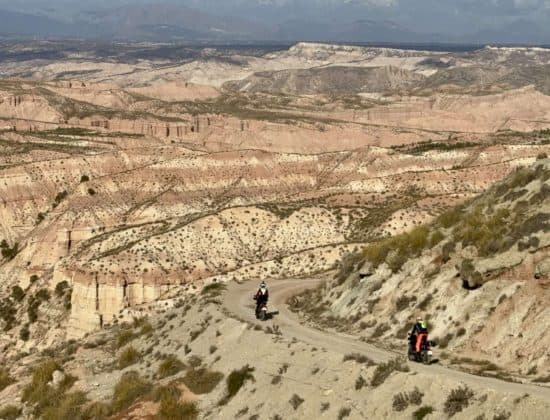 Adventure Touring
Andalusia East Motorcycle Tour Off Road
Andalusia, Spain
Nov 6 – 11 · 6 days · Aries Moto Tours
€1,490 / person
 Road Touring
The Ultimate Gourmet Tour
Andalusia, Spain
Dates on request · 8 days · Gourmet Biker Tours
€4,366 / person
 Road Touring
The Signature Gourmet Tour
Andalusia, Spain
Dates on request · 8 days · Gourmet Biker Tours
€3,021 / person
 Road Touring
Grand Andalusia
Andalusia, Spain
Dates on request · 9 days · Aries Moto Tours
€2,990 / person

Crossing borders
Road laws change at every border — know the ones that matter
European roads feel seamless right up until the moment they are not. Speed limits, enforcement culture, mandatory equipment and even helmet standards shift at every border, and "I didn’t know" has never once worked on a roadside official. The good news: the list of rules that actually bite touring riders is short, and twenty minutes of reading covers a whole itinerary.
Mandatory kit is the classic trap. France requires every rider to carry a high-visibility vest and, technically, spare bulbs; Spain requires the vest to be worn if you stop on the carriageway, which means it must be reachable without opening luggage — a rule that catches out riders whose vest is at the bottom of a pannier. Several countries require a first aid kit and warning triangle for any vehicle. The pattern to internalise: pack a vest per rider where you can grab it, and check each country’s current list the week before departure, because these rules genuinely change year to year.
Speed enforcement deserves respect in specific places. France’s automated network is dense and cross-border penalties are enforced; Switzerland treats speeding as a criminal matter at surprisingly modest margins, with fines indexed to income; Norway’s limits are low and its patience is lower. Ride to the posted numbers in those three and you will keep both your licence and your holiday budget intact.
Smaller print worth knowing: daytime headlights are mandatory for motorcycles almost everywhere in Europe (modern bikes handle this for you); some Alpine tunnels and Italian ZTL historic-centre zones carry camera-enforced fines that arrive months later; and helmet-mounted cameras remain legally grey in a few countries. None of this is a reason to stay home — it is simply the local grammar of roads you are a guest on. Operators brief all of it on guided tours, which is one more thing the format quietly handles for you.


Your bike
Motorcycle insurance for riding abroad
Your bike policy is the first of the two insurances that matter, and the question to ask is precise: am I covered, at my current level of cover, in every country on this itinerary? Many policies that promise "European cover" quietly drop from fully comprehensive to third-party-only the moment you cross the Channel, which means a slide on Andorran gravel could total your bike at your own expense while you remain politely legal. Ring your insurer, name the countries, and get the answer in writing — it takes ten minutes and settles the single most expensive unknown of the trip.
Geography needs checking too. Standard European cover typically means the EU plus EEA neighbours, but itineraries that touch Morocco, the western Balkans or Türkiye often need an extension or a Green Card — the international proof-of-insurance document — and insurers want days, not hours, of notice to issue one. If your route includes a ferry hop to North Africa, this is the paragraph that saves the trip.
Breakdown cover is the sibling policy touring riders actually use. European breakdown with repatriation means a bike that dies in the Dolomites comes home on a truck instead of becoming a long-term Italian resident, and the better policies cover onward travel so the holiday survives the mechanical failure. Check whether your bank account or existing policy already includes it before buying twice.
Riding a hire bike changes the shape of the question: insurance is bundled, but the excess — your liability for damage — can run to thousands of euros. Read the hire agreement’s excess figure before you commit, and price the operator’s excess-reduction option against a standalone excess policy from home, which is routinely half the cost. And photograph the bike, every panel, timestamped, at handover. It is thirty seconds of pedantry that has ended a thousand disputes before they started.
Yourself
Travel insurance that actually covers motorcycling
The second insurance is the one riders forget: cover for you, not the bike. And the industry’s dirty secret is that most off-the-shelf travel policies exclude motorcycling entirely, or cap it at 125cc "holiday scooters" — meaning the rider who bought a policy in good faith is uninsured the moment they swing a leg over a touring bike. The fix is simple but must be deliberate: buy a policy that names motorcycling on machines of your engine size as a covered activity, in writing, with no weasel words about "incidental use".
The headline numbers to check are medical cover and repatriation. A European health card — the EHIC or its UK successor the GHIC — grants access to state healthcare on local terms, and it is genuinely worth carrying, but it does not touch private clinics, mountain rescue, or the six-figure cost of a medically escorted flight home. That is the job of the travel policy, and it is the entire reason to hold one. Alongside those, confirm cancellation and curtailment cover at the full trip value, personal liability, and — if your itinerary is ambitious — that the policy’s altitude and off-road clauses match where you are actually going.
Read the gear small print while you are there: helmets and riding kit are expensive, and policies vary wildly on single-item limits. Some riders add specialist gear cover; most simply carry receipts and photos of their kit, which smooths any claim.
Finally, make the paperwork reachable. Policy numbers and the insurer’s emergency line saved offline in your phone, a paper copy in the tank bag, and copies with someone at home. In the unlikely hour you need any of this, you will not want to be hunting through email on a hillside. One hour of admin, once — that is the entire price of touring with a clear head.


Documents to carry on tour
Originals where the law requires, copies everywhere else — and everything backed up offline.
- Passport (plus visa where needed) and photo driving licence
- International Driving Permit for countries that require one
- Vehicle registration (V5C) or hire agreement
- Motorcycle insurance certificate / Green Card where required
- Travel insurance policy number and 24-hr emergency line
- EHIC / GHIC card for EU state healthcare
- Breakdown cover details and European claim numbers
- Emergency contacts saved offline — starting with 112

On the road
Riding safely in unfamiliar territory
Everything above is paperwork; this is craft. Riding abroad adds three genuine variables — unfamiliar roads, unfamiliar rules, and other people’s habits — and experienced tourers manage all three with the same tool: margin. Ride at eight-tenths of your home pace for the first two days. Every tour has a settling-in period while your brain recalibrates to new surfaces, new sightlines and, for British and antipodean riders, the other side of the road; the riders who crash on tour overwhelmingly crash early, and overwhelmingly on the side-of-the-road transitions after stops. The veteran trick is a physical reminder on the tank — a sticker, a band — for the first mornings.
Read each country’s traffic like weather. Italian drivers are assertive but predictable — they expect you to hold your line and will use every centimetre of theirs. Rural Spain and Portugal are courteous and slow, with tractors around blind crests as the real hazard. Alpine tourist roads add coaches that need the whole hairpin, and gravel dragged onto the exit of high-side corners by melting snow. None of this is danger — it is texture, and knowing it in advance converts surprises into observations.
Manage the day, not just the corner. Heat, altitude and vibration dehydrate riders faster than they notice, and the accident statistics bend upward in the final hour of the afternoon when concentration runs dry. Drink at every stop, eat lightly and often, and treat the 4pm slump as a scheduled event: coffee, ten minutes, then the last leg. If the group is pushing on and your judgement says stop — stop. Any operator worth booking says exactly the same thing at the morning briefing.
And if the worst happens: warning triangle out, vest on, 112 — one number, every EU country, English-speaking operators. Then the insurer’s line, then the operator’s. You built this list before you left; that is why the bad hour stays merely a bad hour.
Cover yourself in four steps
Know the local road laws
Traffic laws differ significantly across countries — speed limits, overtaking rules, helmet standards, and mandatory kit vary widely. In France, Spain, and Portugal you must carry a high-visibility vest accessible without opening luggage. In some countries, daytime headlights are mandatory.
Check your motorcycle insurance
Verify your policy covers touring abroad and every country on your itinerary. Many standard policies exclude off-road riding or specific non-EU countries. Consider a touring-specific policy that includes breakdown recovery and repatriation of your bike.
Get the right travel insurance
Separate travel insurance covering motorcycling is essential. The EHIC/GHIC covers state medical treatment in EU countries but not repatriation or private hospitals. Look for policies that explicitly list motorcycling as a covered activity — not all do.
Emergency preparedness
Save 112 (the EU universal emergency number) and local equivalents before entering each country. Share your itinerary with someone at home. For remote routes, consider a satellite communicator. Know how to describe your location in the local language — offline translation works well.
Frequently asked questions
The questions riders ask most before booking.
Keep reading

Gear guide
Motorcycle Touring Gear: The Complete Checklist for Any Climate
The right gear is the difference between enjoying a tour and enduring it. This guide covers what to wear from helmet to boots, how to choose a luggage system, the art of packing light, and how to prepare your bike — with a packing checklist you can actually use.

Beginners guide
Your First Motorcycle Holiday: The Complete Beginner’s Guide
Thinking about your first motorcycle holiday? This guide covers everything a first-timer needs — how to choose a beginner-friendly tour, what it costs, how booking works, and what the support around you actually looks like — so you can book with confidence.

Your first tour
What to Expect on a Motorcycle Tour: An Honest Day-by-Day Picture
Not sure what a motorcycle holiday actually looks like day to day? Here’s the honest picture — the morning briefings, the riding rhythm, the people you’ll share it with, the evenings, and what really happens when a bike gets a flat halfway up a mountain.
About the author
Ben Crawford
Co-founder
Ben Crawford is a co-founder of Motorcycle Holiday: a software nut by day and an adventure rider by dream. He builds the site that helps riders find the right tour.